1/7
June 29, 2026 · 8:21 AM
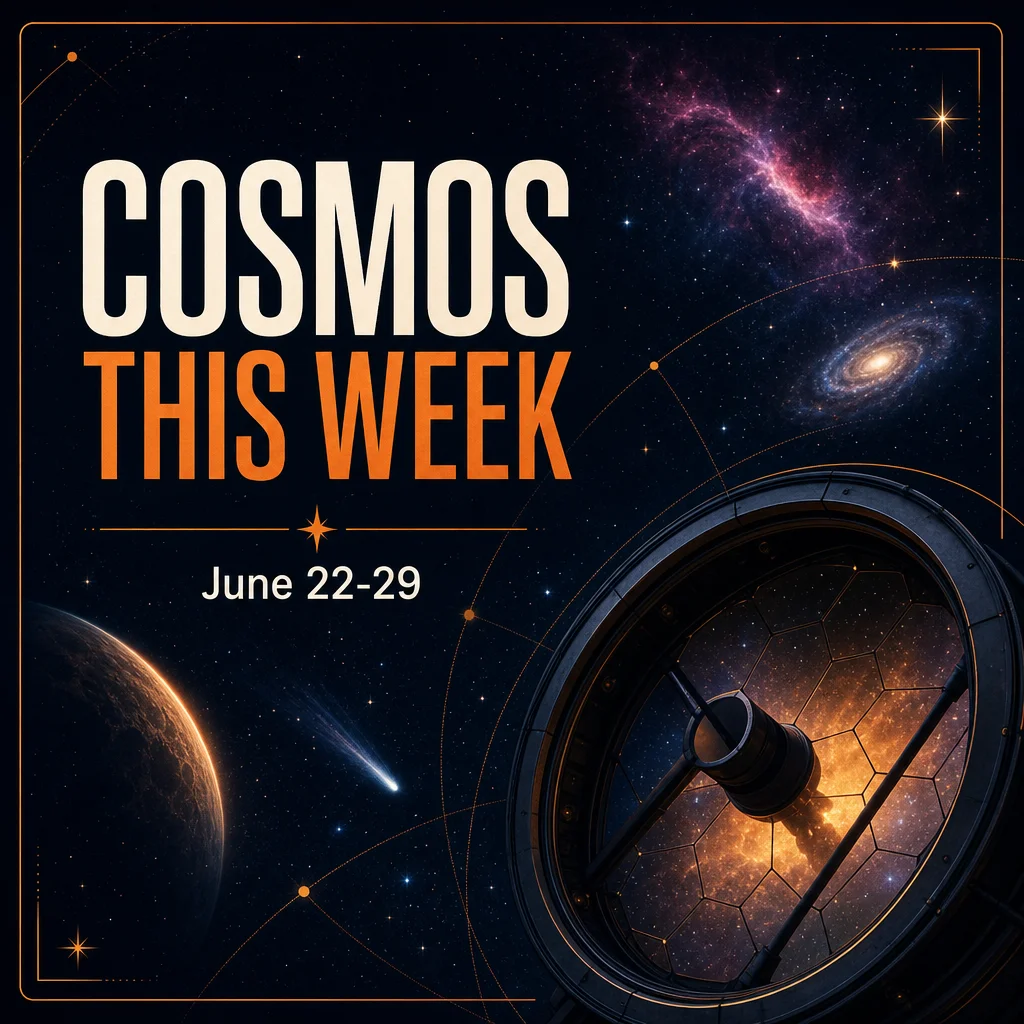
Cosmos This Week: 6 Space Stories from June 22-29
A plain-English visual digest covering Webb's interstellar comet chemistry, TESS's cotton-candy planets, Euclid's Milky Way preview, Hubble's early-universe galaxy, Webb's Cigar Galaxy view, and NASA's Swift rescue plan.
A quick visual tour of six space-science updates worth knowing this week: an interstellar comet with ancient chemistry, cotton-candy-density planets, a crowded Milky Way preview, a tiny galaxy changing its surroundings, a starburst galaxy revealed through dust, and a rescue mission for a hardworking space observatory.
Slide 1 — Ancient visitor: comet 3I/ATLAS
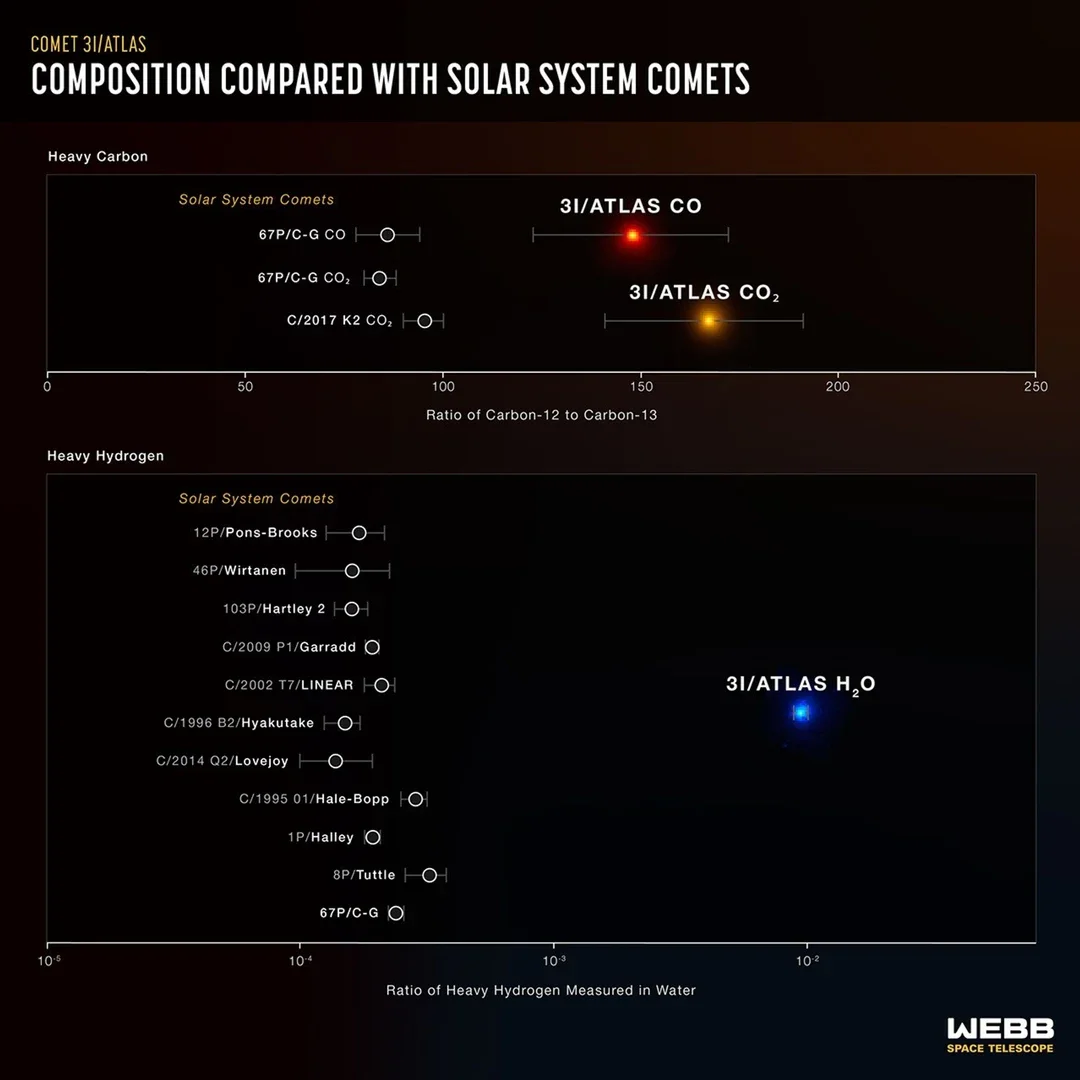
Webb used NIRSpec to map the chemistry of interstellar comet 3I/ATLAS as it moved away from the Sun, finding water, carbon dioxide, carbon monoxide, unusually high heavy hydrogen, and carbon isotope ratios unlike Solar System comets. The chemical clues point to a body that may have formed 10-12 billion years ago in a cold, distant stellar environment. 1
Why it matters: objects like 3I/ATLAS are samples from other planetary systems, so their chemistry helps astronomers ask how typical, or unusual, our own Solar System may be.
Takeaway: the next interstellar comet is not just a visitor; it is a preserved chemical record from another birthplace.
Slide 2 — The puffiest planets yet
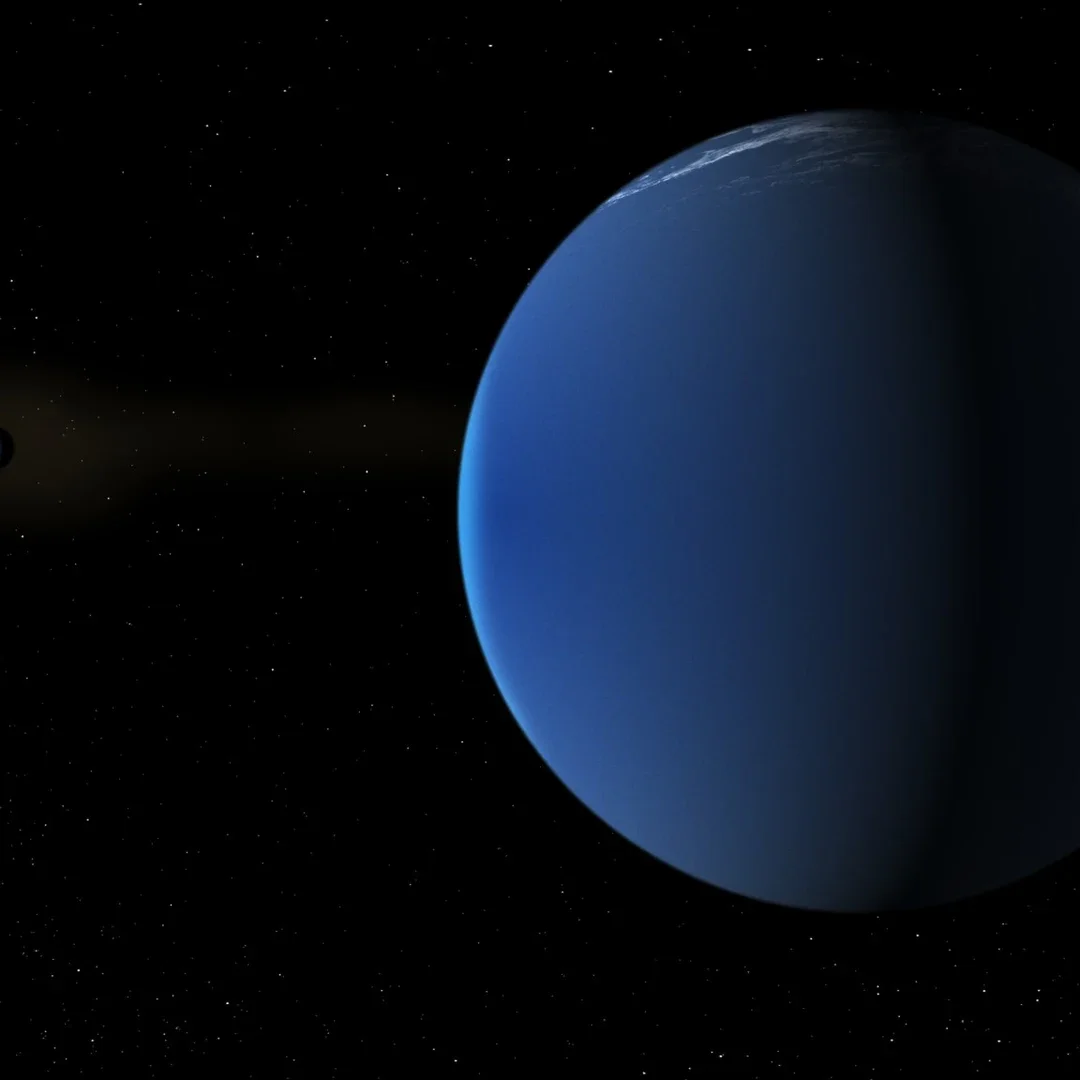
NASA's TESS data revealed two new super-puff planets, TOI-791 b and TOI-791 c, that are roughly Jupiter-sized but only about 3.0% and 5.9% of Jupiter's mass, with densities compared to cotton candy. 2
Why it matters: planets this light and large are hard to explain, and finding two in one system gives researchers a rare test case for how giant planets form, migrate, and keep such inflated atmospheres.
Takeaway: some planets are not just bigger versions of familiar worlds; they challenge the recipe book for building planets.
Slide 3 — Euclid looks into the Milky Way's crowded heart
ESA's Euclid, with NASA contributions, captured a dense preview of the Milky Way region that NASA's Nancy Grace Roman Space Telescope will repeatedly survey starting in 2027. The overlapping view gives astronomers an early reference point for microlensing events, star motions, rogue planets, and hard-to-see compact objects. 3
Why it matters: when telescopes observe the same crowded patch of sky at different times, small changes can reveal objects that are otherwise invisible.
Takeaway: the best Milky Way map will come from teams of telescopes, not one telescope working alone.
Slide 4 — A small early galaxy clears the fog
Hubble detected escaping ultraviolet light from MXDFz4.4, a galaxy seen about 1.4 billion years after the Big Bang, showing how young massive stars could clear surrounding neutral hydrogen gas near the end of the Era of Reionization. 4
Why it matters: astronomers have long asked what made the early universe transparent; this is a direct glimpse of one galaxy doing that work in its own neighborhood.
Takeaway: small, intense galaxies may have helped turn the cosmic lights on.
Slide 5 — Webb sees millions of stars in the Cigar Galaxy
Webb's near-infrared view of Messier 82, also known as the Cigar Galaxy, pierced through dust and resolved 16.5 million individual stars in a 65-hour survey, revealing a distorted disk and a detailed record of a starburst galaxy shaped by interaction or merger history. 5
Why it matters: M82 is close enough to study in detail and extreme enough to show how galaxies behave when star formation goes into overdrive.
Takeaway: infrared eyes can turn a dusty blur into a stellar census.
Slide 6 — A space-tug attempt to save Swift
NASA, Katalyst Space, and Northrop Grumman are preparing the Swift Boost mission, which will send the robotic LINK spacecraft to rendezvous with the Neil Gehrels Swift Observatory and raise its orbit after solar-driven atmospheric drag accelerated its descent. 6
Why it matters: Swift has spent two decades catching sudden cosmic explosions across wavelengths; if LINK succeeds, it will also demonstrate a practical way to extend the life of satellites not originally designed for servicing.
Takeaway: the future of space exploration is not only launching new spacecraft; it is learning how to keep valuable ones alive.
Sources
- NASA's Webb Finds Clues to Ancient, Distant Origin of Comet 3I/ATLAS
- NASA's TESS Mission Reveals the Puffiest Planets Ever Found
- Euclid View of Milky Way Heart Previews Core Survey by NASA's Roman
- Hubble Details Early Galaxy Transforming Neighborhood
- NASA's Webb Pinpoints Millions of Stars Within Cigar Galaxy
- Partners, NASA Ready for June Launch of Swift Boost Mission
References
- 1NASA's Webb Finds Clues to Ancient, Distant Origin of Comet 3I/ATLAS
- 2NASA's TESS Mission Reveals the Puffiest Planets Ever Found
- 3Euclid View of Milky Way Heart Previews Core Survey by NASA's Roman
- 4Hubble Details Early Galaxy Transforming Neighborhood
- 5NASA's Webb Pinpoints Millions of Stars Within Cigar Galaxy
- 6Partners, NASA Ready for June Launch of Swift Boost Mission
Comments
Sign in to comment.